Cargo Trailer Camping for Adventure Sports: Mountain Biking, Hiking, and More
Cargo trailer campers are purpose-built for adventure.
The cargo trailer camper keeps your gear dry, organized, and out of your truck bed. Your bikes don't need to come off the rack every night. Your muddy kit goes in a dedicated corner. Your recovery food is in the fridge. The setup that makes weekend camping comfortable also happens to be a very good basecamp for people who want to actually use their time having fun, rather than managing logistics.
This post covers how to configure a cargo trailer camper specifically for adventure sports: how to transport and store bikes, where gear storage actually belongs, how to get the trailer level on uneven forest roads, and what camp setup is best to come home to after a long day outdoors.
This post contains affiliate links. If you purchase through these links, a small commission may be earned at no additional cost to you. Thank you for supporting this content. For our full disclaimer, click here.
Shop this post:
Mountain biking: Getting your bikes there and keeping them safe
Mountain bikes can be tough to transport. They're too big for most car trunks, they scratch against each other on roof racks in tight parking, and a full-suspension bike bouncing around in a truck bed for three hours isn't ideal. A cargo trailer solves this easily. You mount the bikes inside, they travel in a controlled environment, and they're waiting for you when you open the door and are ready to ride.
Fork mounts
The easiest way to secure bikes inside a cargo trailer is a front fork mount for mountain bikes. You remove the front wheel, drop the fork into the mount, and the bike stands upright and locked in place. A 7x16 trailer fits three to four bikes in fork mounts without crowding. A 7x14 fits two comfortably with room for gear alongside them.
Mount them on a wood rail or aluminum track running along one wall rather than bolting directly to the trailer floor. This lets you slide the mounts to adjust spacing as needed and makes the system adaptable if you're hauling two bikes one weekend and four the next.
The front wheels go in a bag hung on the wall or stacked flat under the bed platform. Takes about 30 seconds per bike and means nothing shifts in transit.
Bike washing and post-ride cleanup
If you're riding technical trails, you're coming back muddy. Having a plan for this before you build saves a lot of grief. A few things that work well in a cargo trailer adventure setup:
A dedicated dirty zone near the rear door, separated from the living area by a rubber mat or removable floor section.
A garden sprayer or collapsible bucket for basic bike rinse before loading. Doesn't need to be elaborate. Just enough to get the worst mud off the drivetrain before the bike goes on the fork mount.
A mesh laundry bag hung near the door for wet kit. Keeps damp gear from sitting against dry gear in a stuff sack.
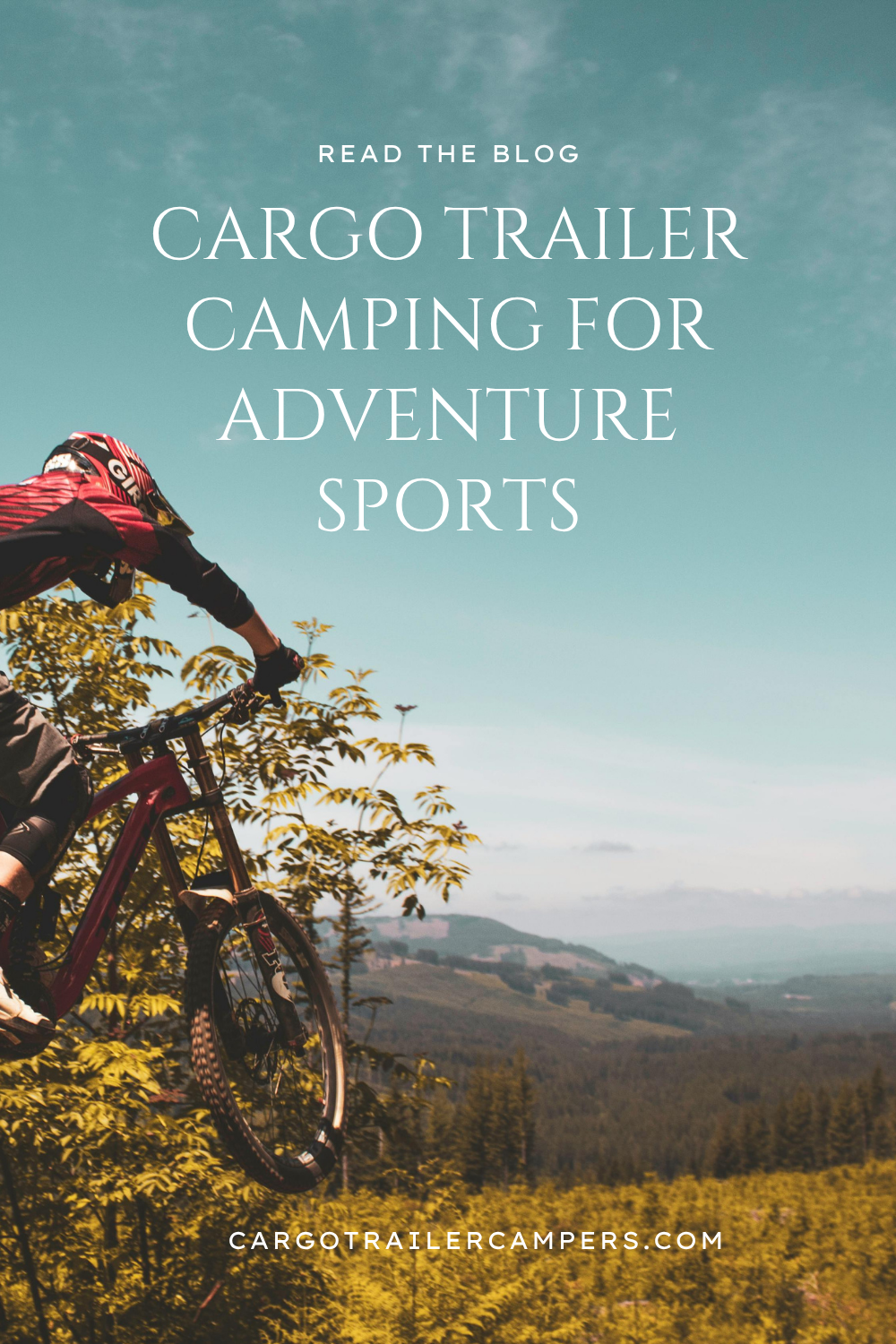
Pin it for Later:
Cargo Trailer Camping for Adventure Sports: Mountain Biking, Hiking, and More
Gear storage: Where everything actually belongs
The cargo trailer adventure camper isn’t as fun when gear ends up piled on the bed, in the walkway, or in a heap near the door. It works when every category of gear has a designated home that it goes back to automatically, without thinking about it, at the end of a tired day on the trail.
Tongue storage
The tongue of a cargo trailer is dead space in most builds. For an adventure setup, it's some of the most useful real estate on the whole rig. A tongue toolbox or tongue storage box mounted on the A-frame gives you a weatherproof compartment that's accessible without opening the trailer. This is where tools, a pump, a tire plug kit, a small first aid kit, and chain lube live. Everything you might need trailside without digging through the whole trailer.
The tongue box also keeps weight forward on the tongue, which improves towing stability. That's a useful side effect of solving a storage problem.
Tongue weight and towing stability
Loading an adventure trailer (bikes, camping gear, tools, food) puts a lot of weight in a small space, and where that weight sits matters. Too much in the rear and the trailer sways. The general rule is 10-15% of total trailer weight should be on the tongue.
A portable trailer tongue scale lets you check this before you leave the driveway. It takes about two minutes and tells you immediately if you need to shift gear forward. If you're regularly running a loaded adventure trailer over a few hundred miles, the Andersen weight distribution hitch is worth the investment. It transfers some of the tongue weight back to the tow vehicle's front axle and makes the whole rig handle more predictably on the highway.
Getting level on forest roads and trailhead parking
Trailhead parking and dispersed camping spots are not level. The ground at most forest service roads has a cross slope, a fore-aft pitch, or both. Sleeping on a surface tilted 5 degrees feels fine the first hour and miserable by 3am. Your fridge also runs harder when it's off level, and if you're running a propane setup, level matters for safe operation.
Leveling options
For quick site-to-site leveling, stackable leveling blocks are the fastest solution. Drive the low-side wheels up onto the stack until the trailer reads level on a bubble level, then chock. Takes two minutes. Works on any firm surface.
For a more permanent solution built into the trailer, mounted scissor jacks or scissor jacks bolted to the trailer frame give you corner-by-corner adjustment without moving the trailer at all. Crank each corner until you're level. More precise than blocks and better for spots where you're staying multiple nights.
The swing down stabilizer jacks are a good complement to either system. They don't level the trailer. They stop it from rocking side-to-side once it's already level. On a soft or slightly uneven surface, a trailer without stabilizers bounces every time someone moves inside. With them down, the trailer stays solid.
Getting in and out of a high trailer
Cargo trailers sit higher than most people expect the first time they stand next to one. The step up into the rear door is awkward, and can be tough with bike shoes or hiking boots. An adjustable RV step bridges that gap. Some adventure campers also build a small fixed step into the rear bumper during the build, but a portable step stool handles it without any fabrication.
Camp setup at the end of a hard day
This is where the cargo trailer camper earns its keep over a tent or a sleeping-in-the-truck setup. After six hours on a trail, you want to eat something real, sit in an actual chair, and not have to think about setting anything up. The trailer is already there. The food is in the fridge. The only question is how good your outside setup is.
Shade and wind
A Coleman screened canopy set up off the rear of the trailer extends your living space into the outdoors and keeps bugs off you while you're eating and recovering. For mountain biking trips specifically, having a bug-free zone to work on a bike or do a basic tune matters as much as the comfort factor. Set it up on the shaded side of the trailer in the afternoon and it becomes the default gathering spot for the rest of the evening.
Seating and horizontal surfaces
Comfortable portable chairs sound like an obvious inclusion but it's worth being specific: not the flimsy folding chairs that come in a carrying bag. Low-slung camp chairs with a proper back that you can actually sit in for two hours after a ride. Your body will thank you. Pair them with a hammock between trees if your site has them. After a long day on the bike, a hammock for 45 minutes before dinner is hard to beat.
Cold food and drinks
A soft-sided cooler lives outside the trailer for the day, stocked with water bottles, recovery drinks, and trail snacks. The 12V refrigerator inside the trailer handles the stuff you don't want warm: post-ride beer, real food for dinner, dairy. Running the 12V fridge off a LiFePO4 battery means you can park at a dispersed site without shore power and still have cold food at the end of the day. A 100Ah lithium battery keeps a 12V compressor fridge running for two to three days without a charge on moderate temperatures.
Lighting and atmosphere
Trailhead and forest service sites are dark. Properly dark, in a way that makes a headlamp actually necessary and makes good camp lighting worth having. Battery-powered lanterns handle task lighting for cooking and eating. String lights strung under the canopy or along the trailer create a lit area that makes camp feel like a place rather than just a parking spot. A portable Bluetooth speaker at low volume and a cold drink after a hard ride. That's what the trailer setup is for.
Inside: keeping an adventure trailer functional
Sleeping after a long day
Sleep quality matters more on a trip where you're exercising every day. A tired body on a thin sleeping pad on a plywood platform is worse than it sounds. Build the bed platform high enough to use the space underneath for gear, and put a proper mattress on it. The difference between a 2-inch foam pad and a real sleeping surface is meaningful when you're doing back-to-back big days.
Heating for shoulder season
Mountain biking and hiking seasons extend into fall in most parts of the country, which means cold nights. Nights in the 30s are common at elevation in September and October, which is also some of the best riding of the year. A Mr. Buddy heater warms a cargo trailer fast. Run it to take the chill off before bed, crack the Maxxair fan for ventilation, and keep a propane gas detector mounted low on the wall. The detector is cheap and important for safety, so don’t skip it.
One more thing: the spare tire
A cargo trailer running on forest roads and rough trailhead approaches should carry a spare. Most do. Most spare tires are also an eyesore bolted to the back of the trailer. A spare tire cover costs almost nothing and makes the back of the trailer look finished rather than improvised. It also protects the tire from UV degradation, which matters if the trailer sits outside most of the year. Small detail, but the kind of thing that separates a built trailer from a box-with-a-bed.
Building for how you actually use it
The adventure sports cargo trailer doesn't need to be elaborate. The core of it is simple: a place to sleep that's close to the trailhead, dry storage for bikes and gear, and enough camp setup to make the evening worth staying for.
What makes it work is specificity. Fork mounts instead of bungee cords. A tongue box instead of a basic crate. A proper leveling system instead of driving around until it feels roughly flat. A real chair instead of sitting on a cooler. Each of these is a small decision that makes the whole trip run smoother, and none of them require a complicated build.